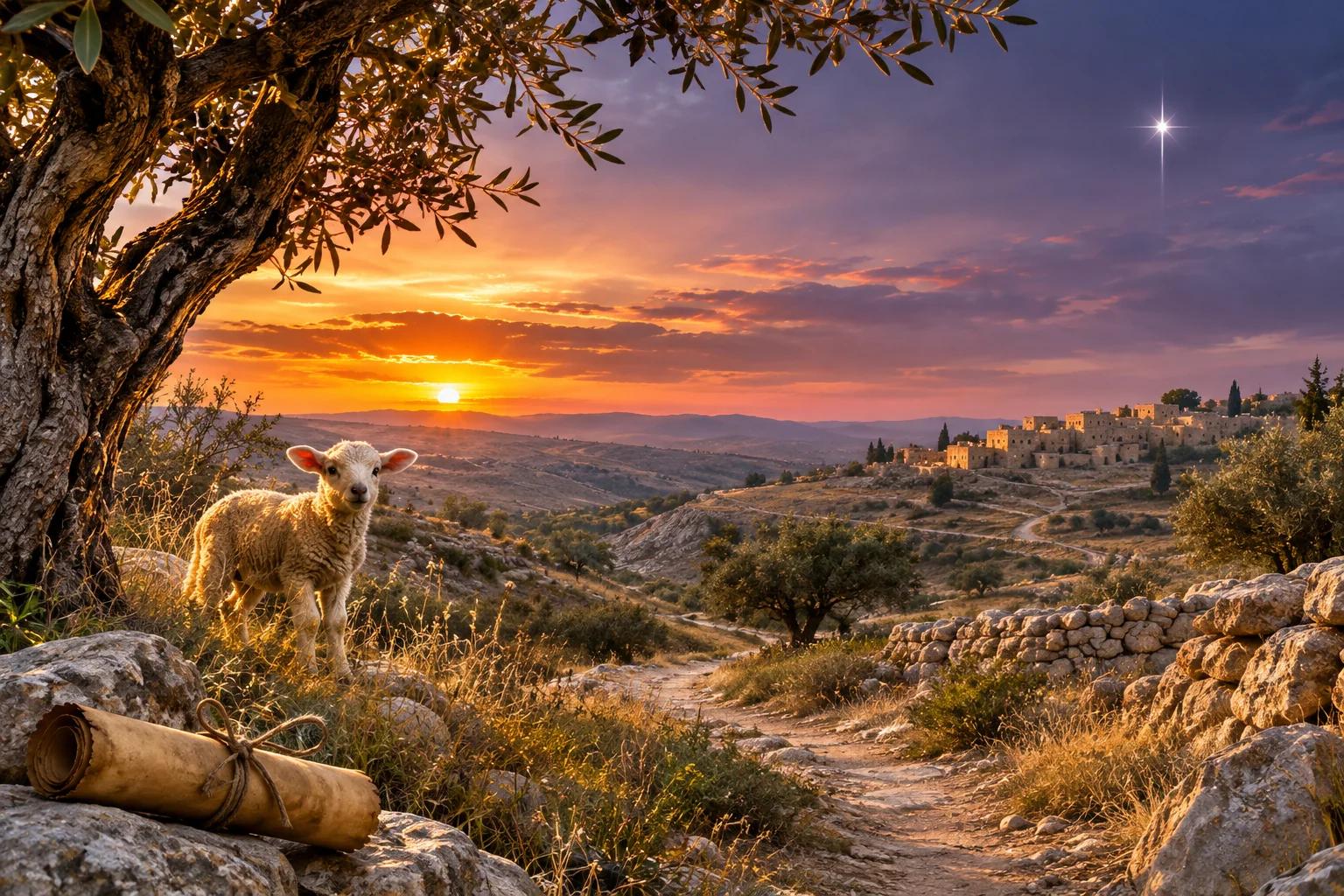
The lamb. The deliverer. The wilderness. The covenant. The king. Coincidence—or a pattern running through the entire Bible?
Divine Threads — Topical Study 03 | English canonical editorial draft | King James Version | November 6, 2026
The question: Did God repeatedly tell the same story long before Jesus was born in Bethlehem? How do the lamb, the deliverer, the wilderness, the covenant, and the promised king belong together?
The short answer: Scripture tells several distinct stories—not five disguised copies of the nativity. Yet these stories contain recurring actions and promises that the New Testament brings together in Jesus Christ. Passover becomes part of the language of Christ's sacrifice; Moses and the exodus shape the language of deliverance; Israel's wilderness testing illuminates Jesus' faithfulness; the new covenant interprets his death; and the promises to David frame his kingship. Some of these connections are explicitly made by New Testament writers. Others are broader Christian patterns that must remain labeled as interpretations. The Bible supplies no authoritative numerical count of how often “the same story” was told.
Our method: First understand each Old Testament passage for Israel in its own setting. Then follow the New Testament's actual words. Finally assess possible larger patterns without claiming archaeology proves divine fulfillment or that every ancient detail secretly predicted Bethlehem.
Start with: “And beginning at Moses and all the prophets, he expounded unto them in all the scriptures the things concerning himself.” — Luke 24:27 (KJV). Read Luke 24.
English KJV study. Biblical claims are distinguished from later typological interpretations; disputed historical and language claims are labeled and research verification continues.
Discover the connection
1. A story told in chapters, not a story repeated word for word
Genesis opens with a world God calls good and a human rebellion that brings shame, alienation, and death (Genesis 1–3). The biblical storyline then moves through families, nations, bondage, liberation, worship, covenant failures, judgment, and hope. By the time Matthew begins with the genealogy of “Jesus Christ, the son of David, the son of Abraham” (Matthew 1:1), those older names carry centuries of significance.
A meaningful pattern is not the same thing as an identical plot. Noah's rescue from judgment is different from Israel's exodus; Abraham's journey is different from David's kingdom. These histories cannot be compressed into a single code. But they repeatedly raise related questions: Who will rescue? How can guilt be dealt with? Who will remain faithful? How can God dwell among his people? Who will rule justly?
The first discovery: The New Testament does not ask readers to forget the earlier stories. Jesus teaches his disciples to read Moses, the Prophets, and the Psalms in relation to himself (Luke 24:27, 44–47). The stronger a connection is in the New Testament itself, the more confidently we may describe it. Read Genesis 3, Matthew 1, and Luke 24.
2. The lamb: deliverance at Passover, sacrifice at the cross
Exodus 12 begins in a specific historical crisis: Israel is enslaved in Egypt and faces the final plague. Each household is instructed concerning a Passover animal, its blood, the meal, and a memorial to be kept by later generations. Exodus 12:13 says, “when I see the blood, I will pass over you”. The point is God's deliverance of his people, not a hidden first-century biography.
Centuries later, John the Baptist calls Jesus “the Lamb of God, which taketh away the sin of the world” (John 1:29). Paul states even more directly, “For even Christ our passover is sacrificed for us” (1 Corinthians 5:7). Peter describes redemption with the precious blood of Christ “as of a lamb without blemish and without spot” (1 Peter 1:18–19).
These New Testament texts give the Christian connection its warrant. But the lamb imagery is not from one identical offering only. Exodus 12 concerns the rescue of a household and a people; Leviticus records several kinds of offerings; Isaiah 53:7 portrays a suffering servant as a lamb led to slaughter. John, Paul, and Peter use related imagery for particular purposes. We must not equate every lamb in the Bible with Jesus or claim that every element of Passover uniquely foretold a scene at Calvary.
Follow the lamb: Exodus 12 → Isaiah 53 → John 1 → 1 Corinthians 5 → 1 Peter 1.
3. The deliverer: Moses leads out; Jesus saves from sin and death
Exodus 2–15 portrays Moses as God's appointed servant in confronting Pharaoh, leading Israel out of bondage, and guiding a people through the sea. The repeated refrain is that the LORD delivers; Moses is not an independent miracle-worker. Exodus 14:13 announces, “stand still, and see the salvation of the LORD”.
Matthew frames Jesus' early life with striking resonances of Israel's story: a threatened child, a cruel ruler, Egypt, and a return (Matthew 2). Matthew 2:15 quotes Hosea 11:1—“Out of Egypt have I called my son”—even though Hosea's original verse remembers Israel's earlier exodus, rather than plainly predicting the itinerary of a future child. This is an example of a New Testament author reapplying an old story; it is not honest to call Hosea 11:1 a simple, exclusively forward-looking prediction.
Jesus' mission also differs from Moses'. The angel tells Joseph that Jesus “shall save his people from their sins” (Matthew 1:21). John 8:34–36 speaks of freedom from slavery to sin, while Hebrews and the Gospels connect deliverance with his death and resurrection. Moses' liberation of Israel and Christ's saving work are related in Christian reading, but their immediate situations and purposes are not interchangeable.
Follow the deliverer: Exodus 3 → Exodus 14 → Hosea 11 → Matthew 2 → John 8.
4. The wilderness: forty years of testing and forty days of faithfulness
Israel passed through the sea and into a wilderness where hunger, thirst, fear, and divided loyalties tested the people. Deuteronomy 8:2 remembers the LORD leading Israel for “these forty years in the wilderness” to humble and prove them. Deuteronomy 6 and 8 insist that Israel should trust God rather than put him to the test.
After Jesus' baptism, Matthew 4:1–11 recounts his temptation in the wilderness during forty days of fasting. When tempted, Jesus answers with the language of Deuteronomy. Matthew 4:4 quotes Deuteronomy 8:3: “Man shall not live by bread alone, but by every word that proceedeth out of the mouth of God.” The other answers likewise come from Deuteronomy (6:13, 16).
Here the pattern is especially visible within the Gospel narrative itself: Jesus enters the wilderness, faces temptation, and responds faithfully using Israel's Scripture. Forty is a recurring biblical number, but the number alone is not proof that any two stories are identical or that every later forty-day event fulfills the same prophecy.
Follow the wilderness: Exodus 16 → Deuteronomy 6 → Deuteronomy 8 → Matthew 3 → Matthew 4.
5. The covenant: a promise deeper than a repeated ceremony
God's covenants throughout Scripture are not identical arrangements. Genesis 9 concerns Noah and the living world; Genesis 12, 15, and 17 concern Abraham and his descendants; Exodus 19–24 concerns Israel at Sinai; 2 Samuel 7 concerns David's house. Each must be read in its own historical setting.
Jeremiah 31:31–34 announces “a new covenant with the house of Israel, and with the house of Judah”. It describes God's law written inwardly, a renewed relationship with his people, and forgiveness. On the night of the Last Supper, Jesus speaks of “the new testament in my blood” (Luke 22:20). Hebrews 8:8–12 then quotes Jeremiah extensively and explicitly applies the new-covenant promise in its argument concerning Christ.
This is not merely a recurring decoration. The old promise and the new quotation are textually connected. Christians nevertheless differ about how the new covenant's provisions relate to Israel, the church, and future fulfillment. The words Israel and Judah belong to Jeremiah's own promise; readers should not erase them.
Follow the covenant: Genesis 12 → Exodus 24 → 2 Samuel 7 → Jeremiah 31 → Luke 22 → Hebrews 8.
6. The king: from David's Bethlehem to Jesus' kingdom
Bethlehem is a town with a story before the birth of Jesus. Ruth's family story leads to David's ancestry (Ruth 4:13–22); Samuel anoints David among Jesse's sons (1 Samuel 16). David later becomes king, and the LORD promises a lasting royal house in 2 Samuel 7:12–16. The royal hope is later developed in passages such as Psalm 2, Isaiah 9:6–7, and Micah 5:2.
Micah names “Bethlehem Ephratah” and speaks of a ruler coming from that place. Matthew 2:1–6 presents Jesus' birth in Bethlehem and uses Micah in the scene with Herod and the scribes. Luke 1:32–33 promises Jesus the throne of David and a kingdom without end. These are stated New Testament connections, not parallels created by a modern chart.
Yet the Gospels do not make Jesus merely another regional monarch. When questioned by Pilate, Jesus says, “My kingdom is not of this world” (John 18:36), describing the nature and source of his rule—not denying the biblical hope of God's kingdom. Christians differ over the exact relationship of present reign and future royal consummation; the central New Testament identification of Jesus as David's promised heir is explicit.
Follow the king: Ruth 4 → 1 Samuel 16 → 2 Samuel 7 → Micah 5 → Matthew 2 → Luke 1.
Free-study conclusion — Coincidence or one unfolding story?
The Bible does not answer the title with a number. It offers something better: five identifiable threads, with multiple passages in each, that the New Testament repeatedly brings into its account of Jesus. Some are direct apostolic claims, some are historical patterns drawn by Gospel writers, and some are broader Christian theological synthesis. The differences matter.
Before Bethlehem, the lamb belonged to Israel's rescue, the deliverer to a real exodus, the wilderness to hard-learned trust, the covenants to particular people and promises, and the king to David's house. Their first meanings were not mistakes waiting to be replaced. The New Testament's claim is that Jesus brings these stories to a new and decisive significance.
Your first reading journey: Exodus 12 → Exodus 14 → Deuteronomy 8 → 2 Samuel 7 → Jeremiah 31 → Micah 5 → Matthew 2 → Matthew 4 → Luke 22 → Hebrews 8 → Revelation 21.
Examine the evidence
Examine the five connections in their original contexts
Plus members can examine Hebrew and Greek terms, five detailed evidence tests, direct quotations, and Scripture-versus-tradition checks.
Explore Plus Evidence · $6.99/monthMembership includes the applicable study level across Divine Threads. No single-article purchase required.
Investigate the ancient world
Explore the historical and biblical investigation
Deep Study members can follow the full investigation across Genesis, Passover, Moses, David, Bethlehem, manuscript history, ancient inscriptions, and contested chronology.
Explore Deep Study · $12.99/monthMembership includes the applicable study level across Divine Threads. No single-article purchase required.